


Dental Implants in Greenwich: Why the Planning Matters More Than the Implant
- Apr 21
- 8 min read

If you have been thinking about dental implants in Greenwich for some time but have not yet gone ahead, you are not alone.
At M Dental Greenwich, many patients come to us after months or even years of hesitation. Sometimes it is fear of the procedure. Sometimes it is uncertainty about whether they are actually suitable. Quite often, it is because they have already had a consultation elsewhere and still do not feel they understand what makes one implant result look and feel natural, while another simply looks like dentistry.
That difference rarely comes down to the implant itself.
In many cases, it comes down to the quality of the planning behind it.
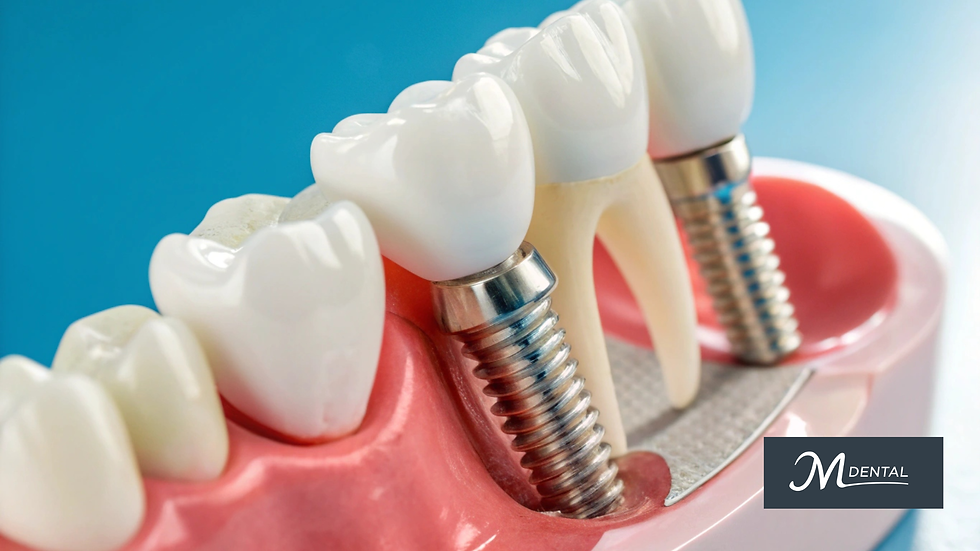
At M Dental Greenwich, implant treatment is not approached as a simple matter of replacing a missing tooth with a titanium post and a crown. It is approached as a restorative treatment, where the final result must work aesthetically, functionally, and biologically over the long term.
That may sound like a subtle distinction, but in implant dentistry it is one of the most important ones.
Why patients often delay implant treatment
Patients who are considering dental implants often ask the same initial questions. Will it hurt? How long does it take? Am I suitable? Is it worth it?
Those are all sensible questions. But they are not usually the questions that determine the quality of the final outcome.
The more important question is whether the implant is being planned around the final tooth, the surrounding tissues, the bite, and the patient's wider smile, or whether it is simply being placed where the bone allows and restored afterwards.
That difference has a direct effect on what can be achieved.
A well-executed implant should not merely fill a gap. It should sit comfortably within the smile, support the bite properly, look proportionate to the surrounding teeth, and remain healthy and maintainable over time. The best implant work tends not to draw attention to itself at all. It simply feels like the tooth has been returned.
This is why experienced implant planning matters so much more than many patients initially realise.
Why the approach behind the implant matters more than the implant itself
Patients often assume the success of implant treatment depends mainly on the implant brand or the surgical stage. In reality, one of the most decisive factors is how the case is planned from the restorative perspective before anything is placed.
An implant is not a natural tooth. It does not erupt, remodel, or adapt in the same way. Once it is placed, many of the key decisions are already fixed. That means position, angulation, depth, spacing, soft tissue support, and restorative design all need to be thought through properly from the start.
If the implant is placed without a clear plan for the final restoration, compromises often follow. Those compromises may not always be obvious to the patient immediately, but they can show up later in the form of poor emergence profile, grey shadowing through the gum, awkward crown proportions, difficult hygiene, food trapping, or a result that simply never feels quite right.
This is especially important in the aesthetic zone, where replacing a front tooth is not just about filling space. It is about symmetry, gum architecture, smile line, lip movement, phonetics, and the way the restoration sits alongside natural teeth under different lighting and from different angles.
That is why, at M Dental Greenwich, implant treatment begins with the end result in mind.
A restorative-led approach to dental implants
At M Dental, implant surgery is carried out by a specialist oral surgeon, but the treatment itself is planned around the restoration from the outset.
Before any implant is placed, careful thought is given to the final tooth. How should it sit within the smile? How should it relate to the opposing teeth? What shape and contour will allow it to look natural? Is the available bone actually in the right position for that result, or does the case need a more considered sequence of treatment?
These are the questions that shape good implant dentistry.
The restorative side of treatment is led by Tim Meskhi, principal dentist at M Dental, with over 20 years of experience in aesthetic and restorative dentistry and a Level 7 qualification in the UK. That matters because placing an implant is only one part of the case. The final result depends on whether the surgical and restorative phases are working towards the same endpoint.
When that planning is done properly, the restoration does not look like an add-on. It belongs in the mouth. It supports the bite correctly, sits well within the gum, and blends with the surrounding teeth in a way that feels natural rather than obviously reconstructed.
Why some implant cases are more complex than they first appear
One of the biggest misconceptions around dental implants is that suitability is simply a case of whether there is enough bone to place an implant.
In reality, there is much more to assess.
Bone volume matters, but so does bone position. Gum health matters, but so does the thickness and quality of the soft tissue. Bite forces matter. Tooth position matters. The smile line matters. Existing wear, clenching, previous dental work, and the condition of adjacent teeth all have a bearing on what is advisable and what kind of result is realistic.
This is why an experienced practice will sometimes recommend preparatory treatment before implant placement, even when the patient had expected a more direct route.
That may involve bone grafting, soft tissue management, orthodontic movement to create the right space, or stabilising the surrounding teeth before the implant is restored. To a patient, that can initially sound like delay. In reality, it is often the difference between a case that is merely possible and one that is genuinely predictable.
Good implant dentistry is not about doing the quickest treatment. It is about choosing the sequence that gives the best long-term result.
Common mistakes patients make when considering dental implants
One of the most common issues we see is patients focusing too much on the implant itself, or the price, rather than the overall planning behind the case.
In some situations, patients have already been offered a quick solution elsewhere, without a clear explanation of how the final result will look or function over the long term.
Another common mistake is assuming that if an implant can be placed, it should be placed immediately. In reality, taking time to prepare the case properly, whether that involves bone support, gum condition, or bite stability, often makes a significant difference to the final outcome.
Good implant dentistry is rarely about doing things quickly. It is about doing them in the right sequence.
A clinical example we often see
A patient may come in having already been told they are suitable for an implant, with the main focus placed on how quickly it can be placed. On closer assessment, however, it may become clear that the future crown position, gum contour, or bite relationship has not been fully planned.
In these situations, treatment may still be possible, but a more considered sequence often leads to a far stronger long-term result, both aesthetically and functionally. That does not necessarily mean the original recommendation was wrong. It means that better planning, carried out before anything is placed, tends to make a meaningful difference to what is ultimately achievable.
When replacing a tooth is not just replacing a tooth
Not every implant case is the same.
Replacing a lower molar at the back of the mouth is a very different exercise from replacing an upper front tooth. A patient with a low smile line and thick gum tissue presents a different restorative challenge from someone with a high smile line, thin tissue, and demanding aesthetic expectations. A single missing tooth in an otherwise healthy mouth is different from a worn dentition where the bite has already changed significantly over time.
These distinctions matter.
They are part of the reason why two patients may both be told they need an implant, yet require very different planning, timelines, and supporting treatment to achieve a result that is stable and natural-looking.
This is also why patients who have already had a bridge, denture, or older dental work often benefit from a more detailed reassessment rather than assuming the next solution will simply follow the same pattern.
At M Dental Greenwich, that broader view is part of the planning process. Implant treatment is considered within the context of the whole mouth, not in isolation.
Will a dental implant look natural?
When implant treatment is properly planned and executed, yes, it can look entirely natural.
But that outcome does not come from the implant alone. It comes from the relationship between the implant position, the surrounding gum, the crown design, the neighbouring teeth, and the patient's own facial and smile dynamics.
This is one of the reasons a premium implant result cannot be judged purely by whether the implant integrates successfully. Osseointegration is important, but it is only one measure of success. A successful implant should also be comfortable, maintainable, harmonious within the smile, and appropriate for the patient over time.
That is the standard M Dental aims for.
How long do dental implants take?
There is no single answer that applies to every patient.
Some cases are relatively straightforward. Others require preparatory work before implant placement or a longer healing phase before the final restoration can be completed.
In general, treatment involves assessment and planning, surgical placement, a healing period while the implant integrates with the bone, and then the final restoration. Very often, that healing phase takes several months. In more complex cases, the full process takes longer because the case demands it.
This is not slow dentistry for the sake of it. It is careful dentistry.
Where implant treatment is rushed, it is often the soft tissue outcome, the aesthetics, or the long-term stability that suffers.
Are dental implants painful?
This is one of the most common questions patients ask, and understandably so.
Implant placement is usually carried out under local anaesthetic, and most patients find the procedure itself more manageable than they had expected. For many, the anticipation is far worse than the experience. Mild soreness afterwards is normal, but in straightforward cases it is often less troublesome than patients imagine beforehand.
The more important point, however, is not simply whether treatment is comfortable on the day. It is whether the treatment is being carried out in a way that is measured, well planned, and appropriate for the specific case.
That is what tends to give patients confidence.
Are dental implants right for everyone?
Not always, and a good practice should be honest about that.
Many adults are suitable for dental implant treatment, but suitability is never decided on a missing tooth alone. It depends on the condition of the surrounding tissues, the available bone, the wider dental picture, the patient's medical history, and what kind of result is actually achievable.
Sometimes the answer is yes straight away. Sometimes the answer is yes, but only with preparatory treatment. Occasionally, the right answer is that another option may be more appropriate.
A proper consultation should make that clear.
Frequently asked questions about dental implants in Greenwich
How much do dental implants cost in Greenwich?
Costs can vary depending on the complexity of the case and whether any preparatory treatment is required. A proper consultation is the best way to understand what would be involved in your situation.
What happens if I leave a missing tooth untreated?
Over time, the surrounding teeth may shift, the bite can change, and bone loss can occur in the area. Addressing it earlier usually allows for a more predictable outcome.
How do I know if I need bone grafting?
This is assessed during your consultation using clinical examination and imaging. It depends not only on how much bone is present, but also where it is positioned in relation to the final restoration.
Book a dental implant consultation in Greenwich
If you have been thinking about replacing a missing tooth but still feel unsure, a proper consultation can give you clarity.
At M Dental Greenwich, we take the time to assess your case carefully, explain what is realistically achievable, and outline the options in a way that makes sense, without pressure.
The goal is not simply to place an implant, but to achieve a result that looks right, functions properly, and lasts over time.
M Dental Greenwich is a short walk from North Greenwich and Cutty Sark stations and welcomes patients from Greenwich, Blackheath, Charlton, Deptford, Woolwich, Isle of Dogs, and across South East London.
M Dental Greenwich
1 Harrison Walk, London, SE10 0YL
0204 541 8517


Comments